Phishing Detection System
Solo MS capstone that rates any URL likely phishing, uncertain, or likely legitimate and explains why. On 136 real brand sites it never trained on, it flagged 4.
Data Scientist · Machine Learning Engineer · Data Analyst · Forward Deployed Engineer
I turn messy data into decisions, and build the models and pipelines behind them. Data science, machine learning, and analytics, taken end to end, from exploratory analysis to a containerized ML system. I also contributed to a production AWS analytics platform.
Currently LLM evaluation, contract with Handshake AI
Tucson, AZ
Seven projects, from a five-layer ML system to data pipelines and databases, including one in progress and one planned. Swipe, or use the arrows; each card opens a write-up with a link to the code.
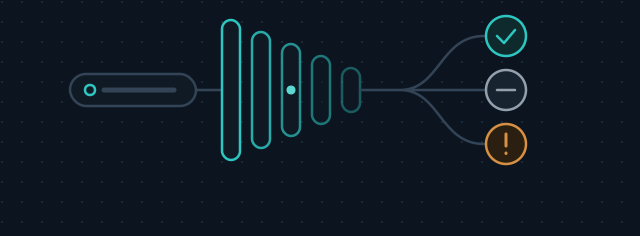
Solo MS capstone that rates any URL likely phishing, uncertain, or likely legitimate and explains why. On 136 real brand sites it never trained on, it flagged 4.
I prototyped a Lambda backend with versioned plan history and revert, as part of a team restructuring a University of Arizona degree-progress platform.
Planned project. A classifier to flag scam, bot, and spam comments on YouTube, built to favor recall, since a missed scam costs more than a false alarm.
Predicts which borrowers are likely to default, using German Credit data. I benchmarked five models; Gradient Boosting came out best at ROC-AUC 0.77.
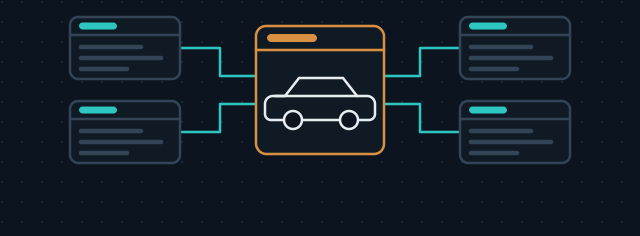
A 25-table relational database for a multi-store car dealership: sales, service, financing, and parts, with 10 analytical queries and 3 reporting views.
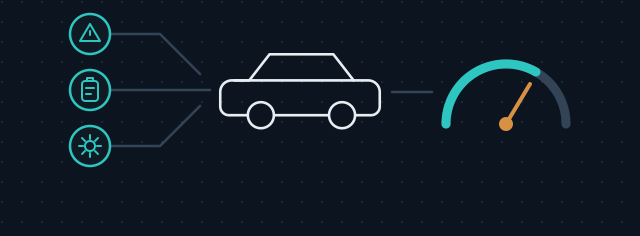
In progress: a reliability score for used cars in a student's budget. Built so far: the NHTSA data pipeline for 30 popular 2012 to 2014 models.
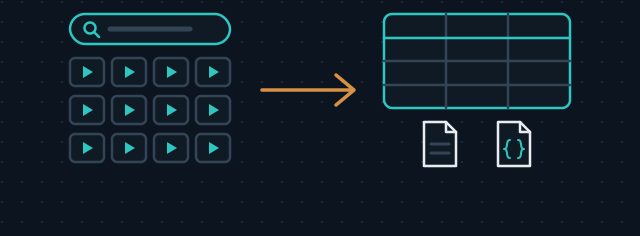
A class notebook that pulls stats for the top 50 YouTube results for one search query through the YouTube Data API and exports them to CSV and JSON.
Currently designing evaluation challenges for large language models on contract with Handshake AI. Before that, 3+ years at Tata Consultancy Services on the Microsoft account, where I built the dashboards, SQL, and Python automation that stakeholders used for release decisions.
Design evaluation challenges that test the reasoning of large language models, and write structured feedback on model behavior.
Built two self-refreshing Power BI dashboards (bug tracking and feature delivery) for Microsoft stakeholders, replacing manual update cycles. Automated SQL querying and Python data collection, saving about 3 days of manual effort per reporting cycle, and ran exploratory data analysis across 300+ test and 180+ defect records each cycle for a cross-functional team of 8, turning findings into stakeholder-ready reporting.
Led two analysts on delivery and data-quality standards, built automated workflows that cut manual data collection, and turned defect-trend analysis into recommendations for developers and QA leads.
Executed 300+ structured checks across Microsoft-product environments, documenting results for QA reporting and building a foundation in structured problem-solving and data validation.
The tools and methods behind the work above.
Verified credentials, each linked to its public verification on Credly.
I am a data scientist and machine learning engineer who likes owning the full arc of a problem: taking something ambiguous and messy, doing the exploratory analysis to understand it, and building it all the way through to a working system other people can use.
I hold an MS in Information Science (Machine Learning) from the University of Arizona (GPA 3.89), and before that I spent 3+ years at Tata Consultancy Services on the Microsoft account, in a client-facing role turning raw data into decisions and building the automation and reporting behind them. That mix, technical depth plus working directly with stakeholders, is exactly what data science, analytics, and forward-deployed roles ask for. I am open to relocating.
Right now I am doing contract work with Handshake AI, designing evaluation challenges for large language model reasoning and writing structured feedback on model behavior. It has taught me how hard it is to test a strong model fairly, which is the kind of judgment teams need when they put models in front of real users.